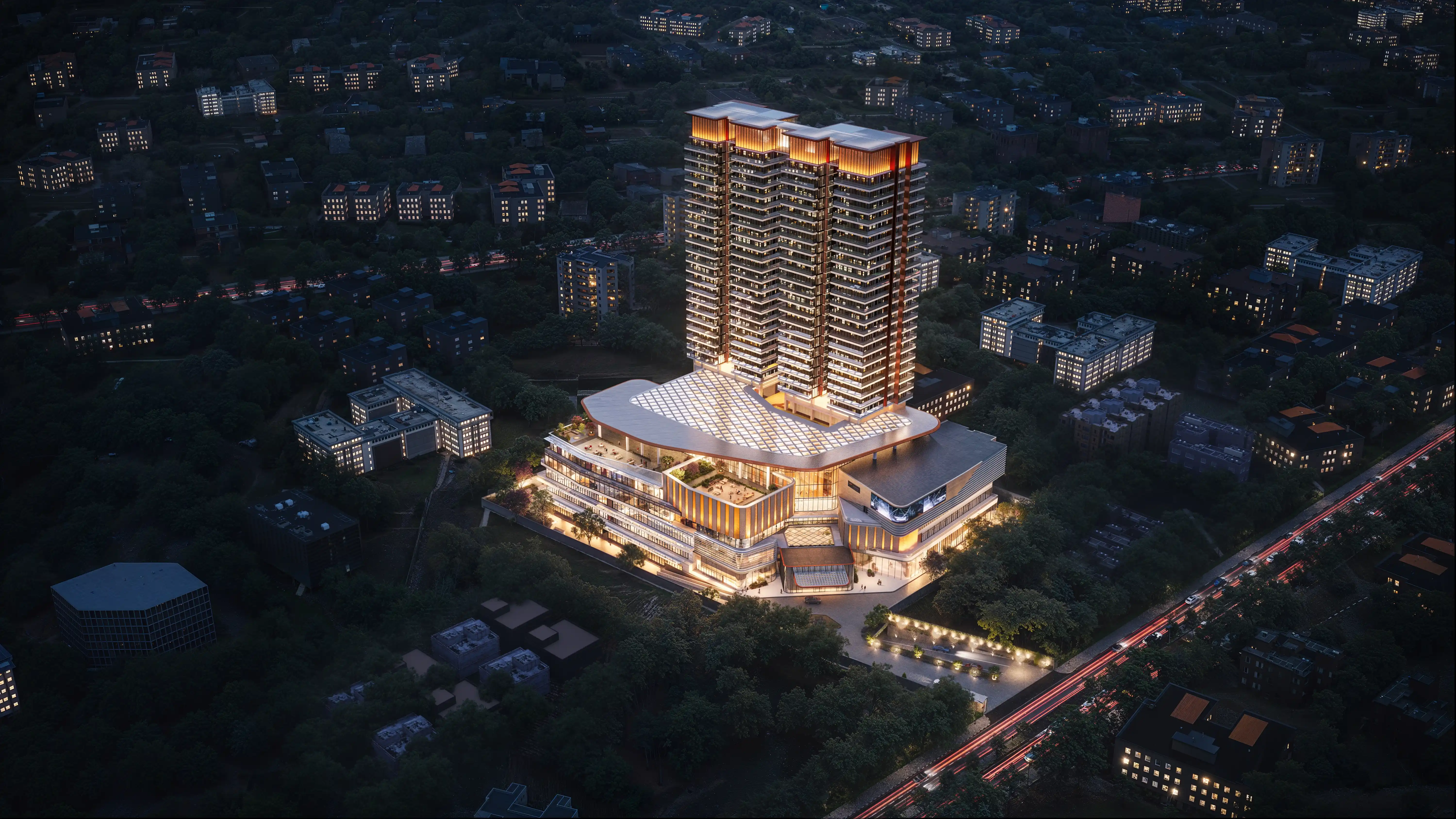
In India, urbanization has rapidly accelerated, driven by increased population density, limited land available for development, changing patterns of how people live, and demand for more diverse project options. Mixed-use development in India is a direct response to these challenges and is considered one of the most future-ready models for growth. to these issues and represents the most future-ready option for growth.
A good definition of mixed-use in relation to real estate is to simply combine multiple functions of living, working, shopping, and interacting within a single project. Mixed-use real estate projects offer a way to compactly combine community components into an efficient, pedestrian-friendly form of urban living, unlike the typical residential development isolated from commercial hubs.
Types of Mixed Use Real Estate Projects
- Vertical mixed-use projects: These are typically residential apartments located above the first-floor commercial/retail space.
- Horizontal mixed-use projects: Large master-planned townships with multiple use zones.
- Transit-oriented cluster: A cluster of integrated projects located within reasonable proximity of major transportation systems.
Real estate development firms like SPJ Group a leading developer known for integrated projects are focused on designing mixed-use projects with considerations of how to create a balance between providing convenience to the residents/employees in order to increase the quality of life and the efficient use of their limited resources.
How Mixed-Use Townships Are Reshaping Indian Cities
- Convenient Living
With many shops, offices, entertainment venues, gyms, and doctors located within walking distance from their homes, people can spend less time commuting. This reduces commuter stress, increases productivity, and improves people’s ability to balance work and family life.
- Utilizing Land Efficiently
Due to the scarcity of land within Indian cities,Vertical mixed-use projects mixed-use developments in India allow for efficient use of land through multiple layers of uses (retail, commercial, and residential projects). This reduces urban sprawl while allowing for compact, sustainable cities.
- A High-Quality Lifestyle Environment
People can work “24x7” anywhere because of integrated developments in India, such as promenades, co-working places, coffee shops, parks, community plazas, and event spaces. The resulting environment enables people to form stronger social interactions and creates a constant stream of people walking through businesses, which ultimately benefits them.
- A Stable Economic Base
All three components (homes, offices, and retailers) are interdependent; homes generate weekday traffic, offices generate weekday crowds, and retailers generate weekend traffic.
RERA: Strengthening Trust in Mixed-Use Real Estate Projects
RERA helps strengthen the credibility of mixed-use developments in India. Many of these large-scale mixed-use developments have multiple phases that are under construction simultaneously. RERA gives developers and buyers assurance that:
-
Every project phase must be registered.
-
Open and honest disclosure of approvals, schedules, and layout.
-
Delivery accountability and progress reports.
Having this level of clarity instills confidence in customers, especially in India, where customers will be investing in multiple phases of large integrated developments
Economic Growth & Investor Confidence in Mixed-Use Developments
Mixed-use developments in India are quickly becoming one of the most profitable categories in real estate for several reasons:
- The Appreciation of Property Value
The property values of mixed-use townships appreciate at a significantly faster rate than those of stand-alone projects because of improved connectivity, walkable community design, and continued foot traffic.
- Higher Rental Income
A mixed-use development has multiple income streams from offices, stores, co-working spaces, restaurants, and residences that provide stability to the project and make it less susceptible to changes in the economy.
- Superior Long-term Stability
Since a mixed-use development contains multiple types of property, the cyclical downturns in an individual sector will not adversely affect the entire development. Instead, these properties are viewed by investors as stable, long-term investments.
Success Stories from Key Cities
The mixed-use real estate trends in Indian cities exemplify their influence on the real estate market. For example:
- Gurugram
Gurugram is regarded as the mixed-use capital of India and possesses numerous integrated areas comprising both residential units and Grade-A office buildings, shopping centers, and entertainment venues.
- Mumbai
In addition, high-density areas of India are seeing many vertical mixed-use developments emerge due to the limited availability of affordable real estate. High-rise buildings are often combined with retail areas on the same floor, commercial space on different floors, and premium rental units, creating compact lifestyle clusters.
- Bengaluru
Another trend emerging from the advancement of technology (i.e., in the realm of mobile telephony) is the transformation of how professionals can balance their work and personal lives by the creation of Tech Parks that combine employment sites with the co-location of residential and recreational areas specifically designed for today’s modern, mobile workforce.
These examples illustrate why commercial and residential projects in India are developing and transitioning to integrated planning.
Tomorrow's Trends: TOD and Green Builds
The future of mixed-use development in India will continue to evolve through two major trends:
- Transit-Oriented Development (TOD)
The expansion of metro rail systems in India is facilitating the development of TODs, which focus on providing safe and convenient walking areas, as well as supporting public transportation use, while reducing the reliance on private vehicles. TODs typically have a higher density of commercial uses due to the constant flow of foot traffic associated with public transportation.
-
Green, Sustainable Urban Design
Today's integrated developments are increasingly incorporating:
* Solar Energy Systems
* Rainwater Harvesting
* Electrical Vehicle Charging Stations
* Low-Energy Building Products
* Large Green Spaces
* Climate-Responsive Architectural Design
Mixed-use developments in India will play an important role in shaping future growth patterns for urban India. On one hand, RERA will promote transparency, and on the other, the establishment of transit-oriented development (TOD) will encourage the use of public transportation. Indian cities will be built with integrated development at their core, with the support of innovative developers like SPJ Group and their driving innovation, SPJ Group's mixed-use vision.
In addition to this, the demand for convenience, community, sustainability, and economic value is creating a greater desire for mixed-use projects than any other type of urban development.
FAQs
- What makes mixed-use development economically desirable?
The creation of multiple income streams from residential, commercial, and retail provides a more stable source of income and, therefore, greater long-term profits than single-use developments.
- How do mixed-use developments support urban revitalisation?
Mixed-use developments are helping to bring life back to underutilised areas of the city by providing a variety of housing, retail, and workplace opportunities on one street or in one area of land. The activation of streets with mixed-use developments will assist in re-establishing vibrancy in urban areas.
- Why are mixed-use developments considered the future of urban planning?
Cities are moving toward compact, sustainable, and transit-friendly layouts. Mixed-use developments reduce commute time, optimize land use, support economic growth, and create self-sustained environments ideal for modern urban living.