UGF- 6, Antriksh Bhawan, KG Marg, New Delhi-110001

For Non-Resident Indians - looking for a location in the Indian real estate market with good corporate demand and infrastructure development, and safe rental income, Gurgaon keeps coming on top. If you’re thinking of investing in commercial property in Gurgaon, the short answer is that the fundamentals are strong, but the regulatory and financial mechanics need to be understood before signing any documents. This blog explains why Gurgaon has become an international capital magnet, the actual permissions and restrictions of FEMA, and how to structure your investment so that it is compliant from day one.
Gurgaon's evolution from being a satellite town of Delhi to a global business hub is not a story of recent vintage. But a new insight into Gurgaon's commercial real estate momentum in 2026 is indeed news. Gurgaon is home to a dense cluster of the likes of Fortune 500s, Global Capability Centres (GCCs), and IT-BPM companies. It is precisely this corporate density that makes NRI real estate in Gurgaon choices more straightforward than in other Indian cities. The and retail assets here are rented by institutional tenants on long, predictable contracts rather than informal deals.
Gurgaon has absorbed most of the demand along the Dwarka Expressway, Golf Course Extension Road, and the Southern Peripheral Road. The infrastructure here is maturing fast enough to keep vacancy rates low, as Delhi NCR led the country in leasing volume in Q3 2025. Industry trackers note that the demand in Gurgaon is led by Global Capability Centres and startup firms. All this accounts for roughly a fifth of the major leases through flexible workspace formats, which is mainly in the IT and ITES sectors, and the hybrid work model, which continues to see favour in Grade-A absorption.
Click for Source
The yield gap of residential and commercial assets is the key number that investors look at first. Commercial properties in Gurgaon are currently offering rental yields that range between approximately 6% to 9% per year, while residential properties in the NCR usually generate a yield of 2% - 3%. Growing in popularity are commercial assets that are leased or rented even before or just after the purchase. It means that the buyer has already found a tenant before he/she even incur the cost of acquiring the property. In top sectors like Golf Course Extension Road, some brokerages report yields climbing as high as 8.5%, with commercial property in Gurgaon on SCO plots along the Dwarka Expressway occasionally crossing the 11% mark due to land ownership advantages Golf Course Extension Road has become a premium corridor paying around 8.5% with strong capital appreciation, while SCO plots on the Dwarka Expressway are seen as offering the strongest returns because investors own the underlying land. Click for Source
This is where most first-time NRI investors get nervous, often unnecessarily. The good news is that FEMA rules commercial property guidelines are considerably more liberal than many people assume.
According to the general permission route, NRIs and OCIs can acquire residential as well as commercial immovable property in India without any prior approval from the Reserve Bank of India (RBI). Under the general permission route, NRIs and OCIs can purchase residential and commercial property in India without prior permission from the RBI.
Every rupee must have a traceable banking trail when payment needs to flow. Money must move through an NRE, NRO, or FCNR(B) account, or be a direct inward remittance – cash, traveller’s cheques, and third-party remittances are not accepted under any circumstances.
Rental income and eventual sale proceeds are generally credited first to your NRO account. The company can repatriate funds of up to USD 1 million per financial year upon documentation and applicable conditions. The money gained from the sale will first go into your NRO account. You can repatriate up to USD 1 million per financial year. Overall, repatriation is also limited.
1. The Ghost-Town Risk (Ghost Malls vs. Active Commerce)
Recent commercial launches in Gurgaon predominantly came up on nascent and far-flung corridors like New Gurgaon or far-out sectors on the Dwarka Expressway. While visually grand, these are typically ringed by underpopulated residential pockets. NRIs often end up with ready-to-move properties sitting idle for years since there is no existing and naturally present resident population that will generate consumption.SPJ Vedatam Mall reverses this and is launching in Sector 14 (Old Gurgaon), a mature and affluent area with a significant, established population of over 500,000+.
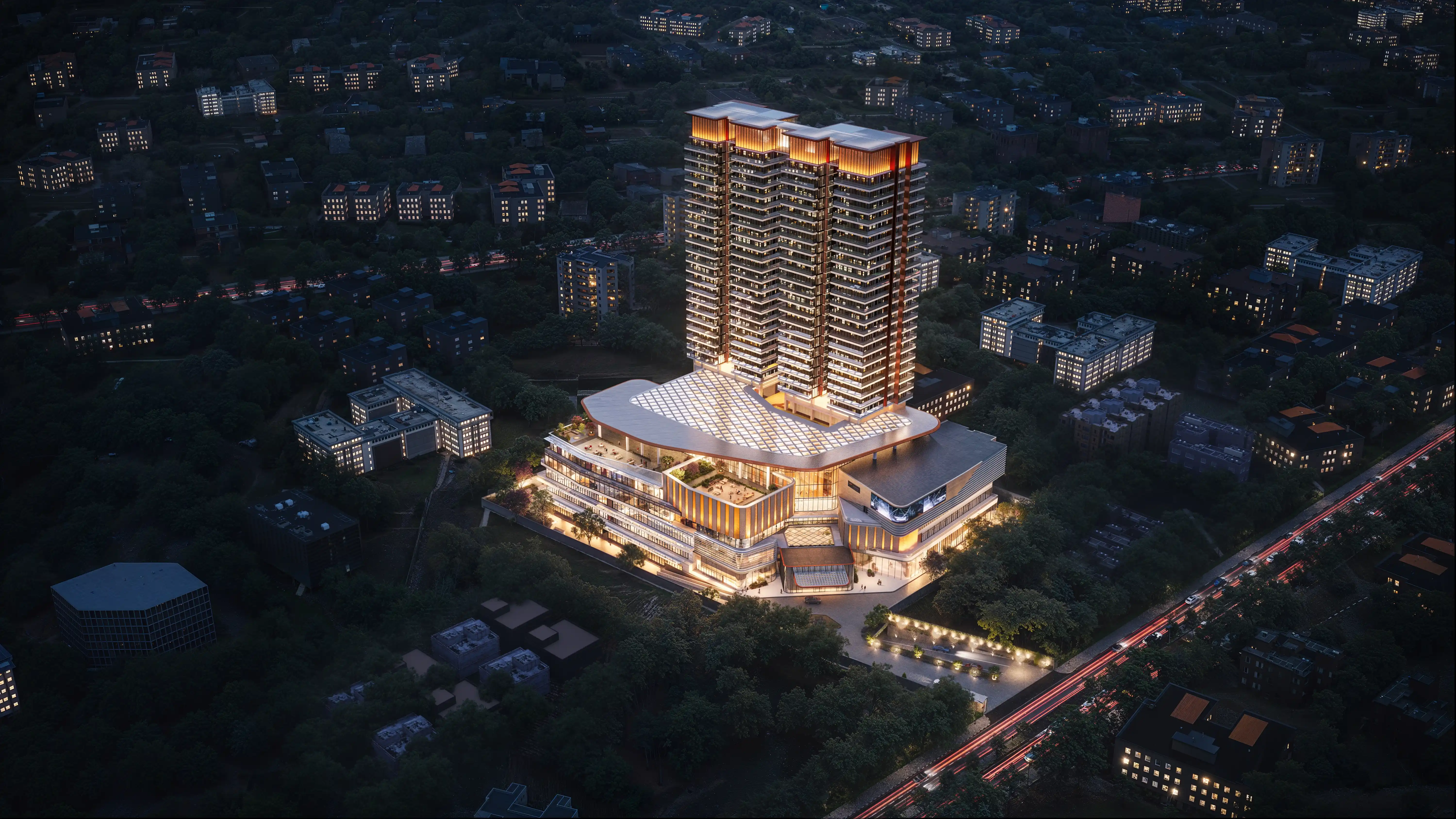
Instead of having to build anticipation for a future population base, Vedatam Mall injects a new, organized lifestyle space, a modern and large (4.15 acres) retail-and-lifestyle hub into an established community that actively craves such an offering. The focus shifts from future promise to current need.
2. The Infrastructure Bottleneck (The Parking Nightmare)
The older high-street markets in core Gurgaon areas (such as Sector 14, or Vyapar Kendra) attract a lot of organic traffic, but are characterized by a state of infrastructural disarray. Awful traffic, no central air-conditioning, and no parking at all, push the big spending, high-end customer towards corporate malls a few highways away.
This problem is being solved by Vedatam Mall’s fully centralized air conditioning, smart high-speed zoning, and enormous three-level basement parking that can accommodate over 1075 vehicles, providing much-needed Grade-A infrastructure at the nucleus of Sector 14, fixing the micro-market’s core problem and bringing home elite local customers looking for quality and convenience without a trek.
3. The "Dead Money" Construction Phase
Buying an under-construction project for an NRI translates into parking capital without generating returns for 3 to 4 years while you wait for possession. Through these years of construction, inflation eats into your capital while you wait, bearing all the risk for no gain and with no liquidity. This entire Vedatam Mall’s financial structure de-risks the entire construction lifecycle by promising you 12% per annum, assured returns during the pre-possession period. Your capital begins yielding from day one of your investment, bringing home guaranteed liquidity directly to your NRE/NRO account as the construction takes place.
4. Distance and Tenant Management Friction
Managing commercial property when you are literally sitting thousands of miles away is a pain in the neck for NRIs. To bring on the right corporate brands, sign multi-year leases, execute the fit-outs, and manage collections each month, you can only rely on local brokers or family – inevitably leading to compromised rentals or longer vacancy cycles. At Vedantam Mall, you get a built-in 7% lease guarantee on rent post possession with our consolidated property management and leasing ecosystem.
The zoning is well-defined floor-wise (Retail - LGG/GG/F1, F&B - F2 & Multiplex - F3/F4), attracting the right premium anchor brands by default. It helps you convert your brick-and-mortar real estate asset into a truly hands-free financial instrument.
5. The "RERA and Timeline" Trust Deficit
Developer default, litigation, and regulatory hiccups are the single most formidable obstacles facing NRIs with investment ambitions for Indian property. When so far removed from the location, it is almost impossible to check the ground level of legal approvals and whether a project really has permission for construction, as they advertise. At Vedatam Mall, regulatory transparency is fundamental, with the project being officially registered with HRERA Reg.
No. GGM/927/659/2025/30 to enforce government-mandated use of escrow accounts (which can only be utilized to build this site), thus assuring you a legally bound delivery on time.
A checklist you need to Follow Before you invest
Open the right type of bank account - You absolutely cannot use a resident’s savings account to buy this. You must use an NRE, NRO, or FCNR account.
Make sure the property is registered with the Haryana RERA authority by the specific developer at the project level, before any advance is paid.
Understand the quality of the tenant if you’re looking at an off-plan purchase. A tenant with a long-lease contract is a different investment profile than someone renting for a retail contract. Don’t be stingy about the bank process. Every single rupee invested must be routed through the bank.
Don’t lose sight of FIRC, TDS proof, and sale deeds, which you will need for compliance as well as repatriation.
Have a chartered accountant (who has experience in cross-border transactions) to guide you through your financing mix. This is particularly important if you plan to mix NRE/NRO savings and potentially take out an Indian mortgage.
The regulatory case for NRIs is unambiguous - you don't need RBI permission, there's no cap on how much commercial property you can own, and the compliance framework, while detailed, is manageable with the right advisors. Combined with yields that consistently outperform residential assets and a corporate tenant base that isn't going anywhere soon, the decision to invest in commercial property in Gurgaon is less about whether the opportunity exists and more about which corridor, asset type, and tenant profile match your investment horizon. As with any NRI commercial property investment in India decision, the returns are strongest for investors who treat due diligence - on the developer, the lease terms, and the FEMA paperwork - as seriously as they treat the yield numbers. With SPJ, the decision to invest in commercial property in Gurgaon is less about whether the opportunity exists and more about which corridor, asset type, and tenant profile match your investment horizon.
1. Can NRIs buy commercial property in Gurgaon without RBI approval?
Yes. Under the general permission route, NRIs and OCIs can purchase both residential and commercial property in India, including in Gurgaon, without prior approval from the Reserve Bank of India. There's also no cap on how much commercial property an NRI can own.
2. What bank account do I need to invest in commercial property in Gurgaon as an NRI?
Payment must be routed through an NRE, NRO, or FCNR(B) account, or come as a direct inward remittance. Cash, traveller's cheques, and third-party remittances are not accepted under FEMA rules for any commercial property purchase.
3. What are the typical rental yields for commercial property in Gurgaon?
Commercial properties in Gurgaon currently offer rental yields of roughly 6% to 9% annually, compared to 2% to 3% for residential assets in the NCR. Some corridors, like Golf Course Extension Road and Dwarka Expressway SCO plots, report yields as high as 8.5% to 11%.
4. How much money can an NRI repatriate after selling commercial property in India?
Sale proceeds are first credited to your NRO account, from where you can repatriate up to USD 1 million per financial year, subject to documentation and applicable conditions.
5. What documents does an NRI need for FEMA compliance on commercial property investment?
Keep FIRC (Foreign Inward Remittance Certificate), TDS proof, and sale deeds on file these are required both for tax compliance and for repatriating funds later.
6. What is the biggest risk for NRIs investing in new commercial launches in Gurgaon?
The main risks are "ghost mall" projects in underpopulated peripheral corridors, poor infrastructure (especially parking), and RERA/delivery uncertainty that's hard to verify from abroad. Checking RERA registration, escrow compliance, and the surrounding residential catchment before investing addresses most of this.
7. Should an NRI hire a CA before investing in Indian commercial property?
Yes a chartered accountant experienced in cross-border transactions is strongly recommended, especially if you plan to mix NRE/NRO funds with an Indian mortgage, since the compliance framework, while manageable, is detailed.
Disclaimer : The information available in this advertisement is subject to change without any notice. While every effort has been made to provide the details, particulars, contents and other graphics appearances in this advertisement as updated, correct, complete and accurate, nevertheless, inadvertent errors may occur in the information. Further, our website(s) and other advertising and publicity material include artist's impressions indicating the anticipated impressions of the appearance of completed development and do not constitute an offer, an invitation to offer and/or commitment of any nature between us and the recipient.
© Copyright 2026 SPJ, All Rights Reserved


